Best Table Tennis Robots for Solo Practice
By RallyRove · 10 min read · Updated June 2026
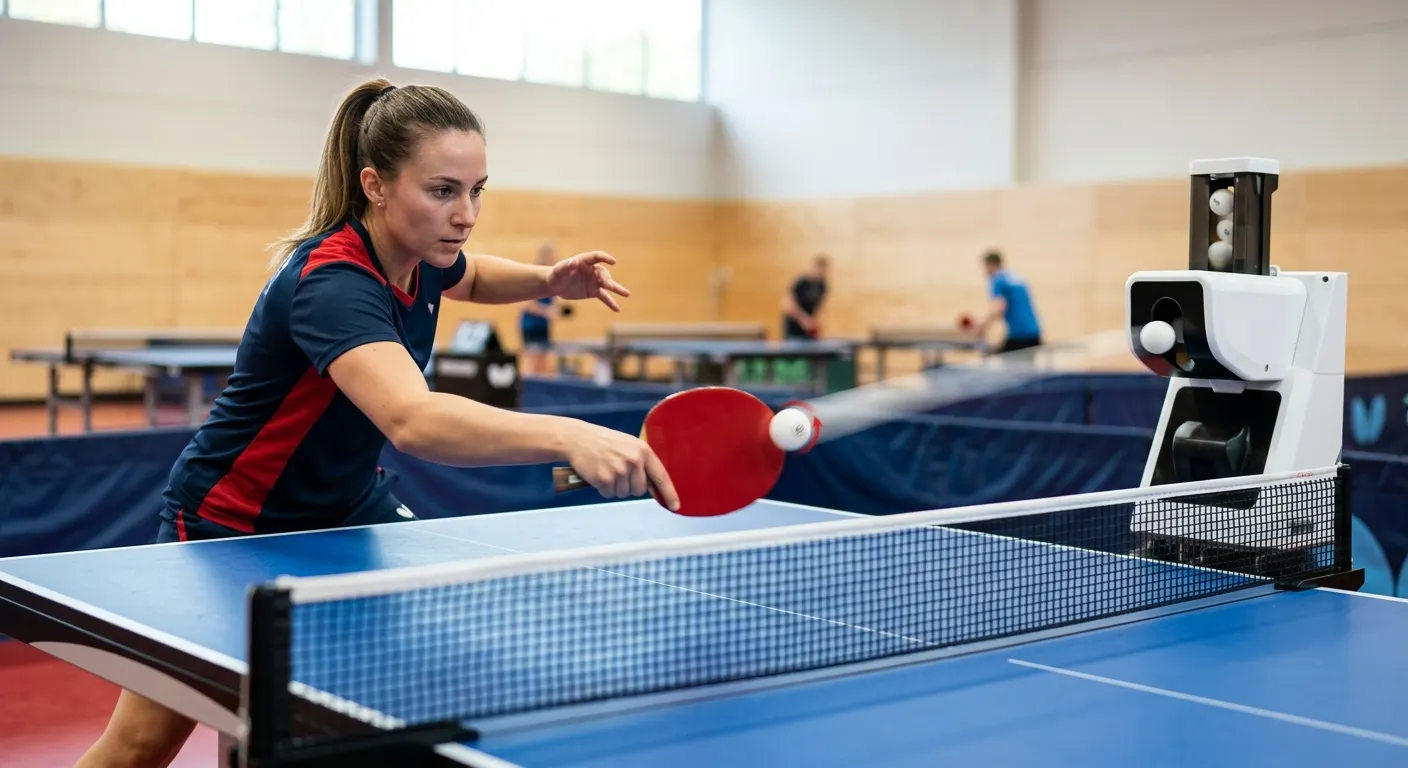
A table tennis robot solves the single biggest limitation that most improving players face: access to consistent ball feed for drill repetition. A coach or practice partner can only feed so many balls in an hour, can only set up so many drill patterns, and costs money for every session. A robot feeds thousands of balls at a preset speed and spin without getting tired, and it does the same drill sequence perfectly every time. For players who are serious about improving but do not have access to daily coaching or a consistent training partner, a robot delivers a measurable return on investment that compounds over months of practice. The Newgy Robo-Pong 2055 is the standard recommendation at the mid-range for most US-based players. Here is how to think about the choice.
Quick answer
The Newgy Robo-Pong 2055 is the best table tennis robot for most serious recreational and competitive players, offering programmable drill sequences, adjustable spin coverage, and reliable feed consistency from a brand with real US service support. Players who want app-controlled multi-drill programming and the widest spin repertoire should consider the Butterfly Amicus Prime at a significantly higher investment.
This guide contains affiliate links. RallyRove may earn a commission at no cost to you.
Why a robot is worth the investment
The core value of a robot is repetition without a scheduling constraint. Improving a table tennis stroke requires hundreds of deliberate, identical contacts. A coach or partner can set up a drill, but they get tired, they chat, and an hour of practice is rarely an hour of pure ball feed. A robot removes all of that friction.
For a player who trains alone, a robot also enables solo footwork training, which is otherwise nearly impossible to replicate. Setting the robot to alternate left-right placement forces active movement on every ball and conditions the footwork patterns that match play demands.
The break-even calculation is straightforward. At $15 to $25 per group coaching session or $50 to $100 per private lesson, a mid-range robot at $400 to $500 pays for itself within a year for a player who practices twice a week. After that, every training session has zero incremental cost.
The Newgy Robo-Pong 2055: the mid-range standard
The Newgy Robo-Pong 2055 has been the default recommendation for US-based players at the serious recreational and competitive level for years, and that reputation is earned. It mounts securely to the end of a regulation table, feeds at adjustable speeds and spins covering topspin, backspin, and sidespin, and allows programmable drill sequences that alternate placement, speed, and spin type.
Its ball recycling system collects balls from the far end of the table via a net that funnels them back into the feeder tray. This design eliminates the need to stop every few minutes to re-collect, which makes extended footwork and multi-ball sessions possible. The system occasionally jams under very heavy use or with irregular balls, so keeping the feeder loaded with consistent-quality training balls is worth the small extra cost.
Newgy has US-based customer support, which matters when troubleshooting the mechanical components that inevitably need attention after intensive use. This is not a trivial advantage over robots from brands that route all support through overseas contact forms.

Newgy Robo-Pong 2055
The mid-range standard for table tennis robots in the US, offering programmed drill sequences, adjustable spin, and oscillation at a price that makes consistent solo training genuinely accessible.
The Newgy Robo-Pong 2040: the entry point
The Newgy Robo-Pong 2040 is the step below the 2055 in Newgy's lineup. It provides basic oscillation and adjustable spin but lacks the programmable drill sequences that make the 2055 more versatile. For a player who primarily wants consistent ball feed for a specific stroke, a backspin push return or a forehand loop against topspin, the 2040 is adequate.
The honest limitation is that without programmable sequences, each drill setup requires manual adjustment between sessions. A player who wants to run varied footwork patterns across a practice session will find the 2040's manual nature limiting. For that type of training, the additional investment in the 2055 pays for itself in session efficiency.

Newgy Robo-Pong 2040
The step below the 2055 in Newgy's lineup, offering basic ball oscillation and adjustable spin without the full programmable drill sequences of the 2055.
The Butterfly Amicus Prime: the advanced option
The Butterfly Amicus Prime Robot represents the top of the consumer robot market. App-controlled drill creation allows sequences of up to 64 ball variations, covering nearly any combination of placement, speed, spin type, and interval. The spin range is wide enough to replicate service spins and looping speeds that approach match-pace delivery.
The price is substantial, well above the Robo-Pong 2055, and the investment is only clearly justified for competitive players who are dedicating serious training time to robot work and want to replicate specific match-condition drills that mid-range robots cannot set up. Club-level competitive players and recreational players will not unlock the full capability of the Amicus Prime in a typical training session.
For most players in the serious recreational and USATT competitive segment, the gap between the 2055 and the Amicus Prime in day-to-day training improvement is smaller than the price gap suggests. Start with the 2055; upgrade only if you find yourself constrained by its programming limits.

Butterfly Amicus Prime Robot
Butterfly's flagship training robot with app-controlled multi-drill programming, wide ball speed range, and the spin consistency needed for advanced stroke training.
Which balls to use with a robot
Robots work best with consistent, uniform balls. Premium balls like the Butterfly R40+ 3-Star Table Tennis Ball (12-pack) or JOOLA Prime 3-Star Table Tennis Ball (12-pack) feed more reliably than irregular training balls because their roundness consistency prevents the tilted feeding and jamming that uneven balls cause in the feeder mechanism.
For extended robot sessions, buying in bulk is economical. The XuShaoFa 3-Star Training Balls (100-pack) 100-pack provides enough balls to fill any robot basket for a full training session without stopping. The quality is lower than tournament balls but sufficient for drill repetition. Reserve the premium balls for match-play training; use the bulk training balls for the robot.
Balls crack and dent faster under robot use than in match play. Inspect your robot ball stock regularly and remove cracked or dented balls. A cracked ball feeds inconsistently and can jam the recycling mechanism, causing more downtime than the replacement cost would have.

Butterfly R40+ 3-Star Table Tennis Ball (12-pack)
The reference-standard poly ball for serious training and competitive club play. Seamless construction and tight roundness tolerances produce consistent bounce and predictable spin response.

XuShaoFa 3-Star Training Balls (100-pack)
High-volume training ball pack for multi-ball practice and robot feeding. Reasonable bounce consistency at a bulk price that makes large-basket practice economical.
Setup and space requirements
Every robot listed here mounts to the end of a full-size regulation table. A half-size table or a conversion top on a dining table will not work with most robot mounting systems. You need a proper table and adequate clearance behind the robot end, typically three to four feet for the net catch system and feeder basket.
Behind the player side, you need at least twelve to fifteen feet of clear space for footwork drills. Shorter spaces can work for stationary stroke drilling but limit the footwork training that makes robots especially valuable. If your practice space is tight, stationary drills are still productive; just plan around the constraint.
Featured in this guide
Newgy Robo-Pong 2055
The mid-range standard for table tennis robots in the US, offering programmed drill sequences, adjustable spin, and oscillation at a price that makes consistent solo training genuinely accessible.
Butterfly Amicus Prime Robot
Butterfly's flagship training robot with app-controlled multi-drill programming, wide ball speed range, and the spin consistency needed for advanced stroke training.
Newgy Robo-Pong 2040
The step below the 2055 in Newgy's lineup, offering basic ball oscillation and adjustable spin without the full programmable drill sequences of the 2055.
Butterfly R40+ 3-Star Table Tennis Ball (12-pack)
The reference-standard poly ball for serious training and competitive club play. Seamless construction and tight roundness tolerances produce consistent bounce and predictable spin response.
XuShaoFa 3-Star Training Balls (100-pack)
High-volume training ball pack for multi-ball practice and robot feeding. Reasonable bounce consistency at a bulk price that makes large-basket practice economical.
FAQ
Frequently asked questions
Is a table tennis robot worth buying for a recreational player?+
If you practice at least twice a week and do not have a consistent partner, yes. A robot eliminates the scheduling problem that limits most recreational improvement: you need hundreds of repetitions to improve a stroke, and a human partner can only deliver so many. The break-even on a mid-range robot against coaching fees or partner practice costs is typically under a year for a dedicated twice-weekly player.
What is the most important feature to look for in a robot?+
Spin coverage and programmable drill sequences are the most important features beyond basic ball feed. Entry-level robots that only oscillate left and right are useful but limited. A robot that can deliver topspin, backspin, and sidespin at adjustable speeds and sequence those variations into programmed drills produces far more training-relevant practice than a simple oscillating feeder.
Do I need a special table for a table tennis robot?+
Yes. Robots mount to a full-size regulation table, which is 9 feet by 5 feet. A dining table or half-size practice table will not accommodate the mounting system properly and will not give the ball trajectory needed for real drill training. If you are considering a robot, a full-size table is the prerequisite.
How many balls do I need to run a robot session effectively?+
For a robot with a recycling net system like the Robo-Pong 2055, the built-in feeder capacity plus the recycled balls from the net are usually sufficient to run a continuous 20 to 30 minute drill session without stopping to re-collect. For longer sessions or robots without recycling, 60 to 100 balls in the tray keeps a drill running for 10 to 15 minutes per refill.